
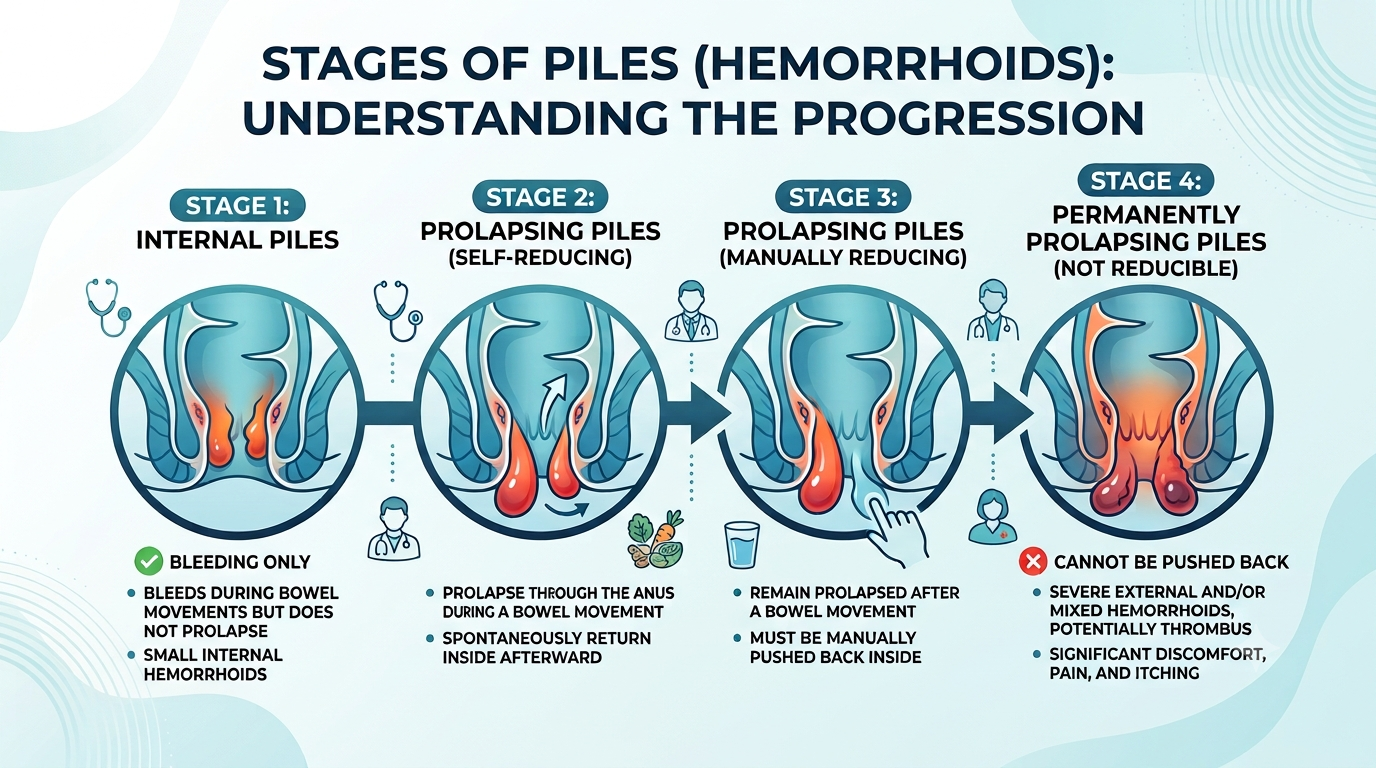
One of the most common questions patients ask after a piles diagnosis is simple: “Do I need surgery?” The honest answer depends on something most people have never heard of before their diagnosis: the grade of their piles.
Doctors don’t just diagnose “piles.” Internal hemorrhoids are classified into four grades, based on how far they prolapse (protrude) from their normal position inside the rectum. The grade isn’t just a technical detail. It directly decides whether you need a procedure at all, and if you do, which one.
This guide walks through what each grade means, the symptoms typical of each stage, and when surgery genuinely becomes necessary versus when it doesn’t.
Understanding the Grading System
Grading applies to internal piles (the ones that develop above the pain-sensing line inside the anal canal). External piles, which develop under the skin around the anus, are assessed differently since they aren’t hidden inside the rectum in the same way.
For internal piles, the grade is based on one main factor: how much the tissue prolapses, and whether it comes back inside on its own.
Grade 1: The Earliest Stage
What it looks like: The piles remain entirely inside the rectum. There’s no visible prolapse at all.
Symptoms: Often just occasional bright red blood on toilet paper or in the bowl, usually after a bowel movement. Because Grade 1 tissue sits above the nerve-dense area of the anal canal, there’s typically little to no pain. Many people don’t even realize they have piles at this stage until bleeding prompts a check-up.
Do you need surgery? No. Grade 1 piles are managed almost entirely through diet and lifestyle: increasing fibre intake, drinking enough water through the day, avoiding straining during bowel movements, and sometimes oral medications that strengthen vein walls. With consistent changes, Grade 1 piles often never progress further.
Grade 2: Prolapse That Resolves on Its Own
What it looks like: The piles prolapse (push out) during straining or a bowel movement, but slide back inside on their own afterward, often without you even noticing it happened.
Symptoms: Bleeding similar to Grade 1, sometimes with mild discomfort or a sense of fullness after passing stool.
Do you need surgery? Usually not. Lifestyle changes alone often aren’t enough to fully resolve Grade 2 piles, but that doesn’t mean surgery is the next step. Minimally invasive, non-surgical office procedures, including laser hemorrhoidoplasty and infrared coagulation, are highly effective at this stage and avoid the recovery time of surgery altogether.
Grade 3: Prolapse That Needs Manual Reduction
What it looks like: The piles prolapse during bowel movements or even physical activity, and no longer go back in on their own. You have to push them back inside manually.
Symptoms: This is where the impact on daily life becomes significant: persistent bleeding (sometimes enough to cause iron-deficiency anaemia if ignored), mucus discharge, discomfort sitting for long periods, and the ongoing stress of managing prolapse throughout the day.
Do you need surgery? In most cases, yes, some form of procedure is needed at this stage, since conservative management alone rarely gives lasting relief once prolapse requires manual reduction. The specific approach depends on severity. For moderate Grade 3 cases, laser treatment for piles can still be effective. For more advanced Grade 3 presentations, options like doppler-guided hemorrhoidal artery ligation may be recommended. This is one of the most common stages patients present at, and it’s also where the right procedure choice matters most.
Grade 4: Permanently Prolapsed
What it looks like: The piles remain prolapsed outside the anus permanently and cannot be pushed back in.
Symptoms: Significant pain, difficulty sitting, walking, or standing comfortably, and a noticeable impact on day-to-day life. Grade 4 piles can also become thrombosed (develop a blood clot) or ulcerated if left untreated, which increases both discomfort and risk.
Do you need surgery? Yes. Grade 4 is the stage where surgical treatment, typically excisional hemorrhoidectomy or stapled hemorrhoidopexy, becomes necessary. Left untreated, Grade 4 piles don’t resolve on their own and can lead to more serious complications. This is not a stage to wait out.
So, When Do You Actually Need Surgery?
Here’s the short version:
- Grade 1: No procedure needed. Diet and lifestyle only.
- Grade 2: Usually no surgery. Minimally invasive, non-surgical options work well.
- Grade 3: Usually needs a procedure, often still minimally invasive rather than traditional surgery.
- Grade 4: Needs surgical treatment.
The grade matters more than how a patient “feels” about their symptoms. Some Grade 2 patients feel quite bothered by mild symptoms, while some Grade 3 patients have adapted to their discomfort and underestimate how advanced their case actually is. This is exactly why a proper examination matters more than guessing based on symptoms alone.
Why an Accurate Diagnosis Matters
Grading piles correctly is what prevents two common mistakes: undertreating a case that genuinely needs a procedure, and pushing a patient into surgery they didn’t actually need. An accurate grade, confirmed through a proper clinical examination, is what allows a treatment plan that matches your actual condition rather than a one-size-fits-all approach.
Dr. Avinash Vagha brings over 40 years of medical experience and more than two decades as a specialist in General and Laparoscopic Surgery, with fellowships including FALS, FMAS, and FIAGES. Every patient is examined and graded individually before any treatment is recommended, whether that means simple lifestyle guidance or a same-day laser procedure.
If you’re dealing with symptoms and aren’t sure how serious your case is, the safest next step is a proper evaluation, not guesswork.
Frequently Asked Questions
Can Grade 1 piles heal completely without treatment?
Yes, in most cases. With consistent dietary fibre, hydration, and avoiding straining, Grade 1 piles often resolve and don’t progress further.
Can piles go from Grade 2 back to Grade 1?
With early, consistent lifestyle changes, symptoms can improve significantly, though the grading itself reflects the physical state of the tissue at the time of examination.
Is Grade 3 always painful?
Not always. Some Grade 3 patients experience more discomfort from bleeding and prolapse management than from pain itself. Pain tends to become more prominent as the condition advances toward Grade 4.
Can Grade 4 piles be treated without traditional surgery?
Grade 4 typically requires a surgical approach, though modern options like laser-assisted procedures can still make recovery considerably easier than traditional open surgery.
How do I know what grade my piles are?
Only a clinical examination can confirm this accurately. Self-assessing based on symptoms alone often leads to over- or underestimating severity.