
If you’ve been living with piles for a while, you’ve probably already come across the term “laser treatment,” and probably also a lot of conflicting information about it. Is it really painless? How long does recovery take? Is it right for your grade of piles, or is it just a marketing term for the same old surgery?
This guide breaks down exactly what happens during laser treatment for piles, what to expect afterward, and how to know if you’re a suitable candidate. It’s based on how Dr. Avinash Vagha approaches the procedure at his Pune clinic.
What Is Laser Treatment for Piles?
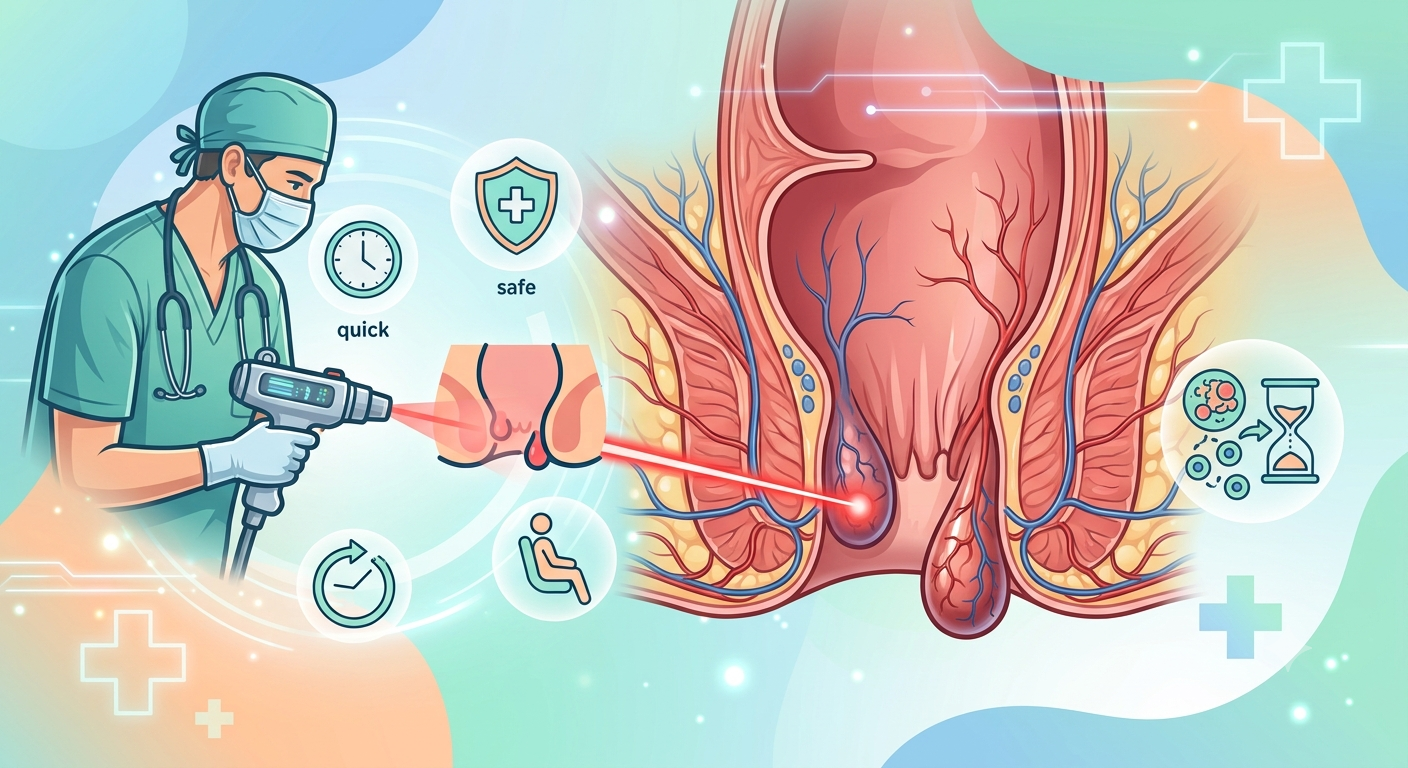
Laser treatment for hemorrhoids (medically called laser hemorrhoidoplasty) uses a thin laser fibre to seal off the blood vessels feeding the swollen hemorrhoidal tissue. Once the blood supply is cut off, the piles gradually shrink over the following weeks instead of being cut out the way they are in traditional surgery.
This is different from conventional hemorrhoidectomy, where the hemorrhoid tissue is surgically excised, often leaving an open wound that takes longer to heal. Because laser treatment doesn’t involve any major cutting, it’s generally associated with less pain, less bleeding, and a noticeably shorter recovery.
How the Procedure Works
A typical laser procedure for piles follows these steps:
- Anesthesia. Depending on the case, this may be spinal, local, or short-acting general anesthesia. You won’t feel the procedure itself.
- Positioning. You’ll be positioned to give the surgeon clear access to the anal canal.
- Locating the piles. A proctoscope (a small viewing tube) is used to identify the hemorrhoidal tissue and the vessels feeding it.
- Laser application. A thin laser fibre is inserted and precisely directed at each hemorrhoid, sealing the feeding vessel and causing controlled shrinkage of the tissue.
- Closure. There’s typically no external cut or stitches needed, which is a big part of why recovery is faster.
The procedure itself usually takes around 20 to 45 minutes, and in most cases, it’s done as a day-care procedure, meaning you can go home the same day rather than staying admitted overnight.
Benefits of Laser Treatment Over Traditional Surgery
- Less pain. Because there’s minimal cutting of skin or tissue, post-operative pain is significantly lower than with conventional hemorrhoidectomy.
- Faster recovery. Many patients are back to light routine activity within 2 to 4 days, and largely settled within 1 to 2 weeks.
- No stitches, minimal bleeding. The sealed vessels mean much less bleeding during and after the procedure.
- Day-care procedure. No extended hospital stay in most cases.
- Lower recurrence when combined with lifestyle correction, especially when constipation and straining are addressed alongside treatment.
What Recovery Actually Looks Like
Recovery timelines vary by individual and by the grade of piles treated, but here’s a general picture:
- First 24 to 48 hours: Mild discomfort, especially around bowel movements. Pain is usually manageable with prescribed medication and is noticeably lower than after conventional surgery.
- Days 3 to 5: Most patients can resume desk-based work or light routine. Some soreness during bowel movements is normal.
- Week 1 to 2: Full return to normal activity for most patients. The treated tissue continues to shrink gradually over several weeks.
- Weeks 3 to 6: The hemorrhoidal tissue continues reducing in size internally, even though you’ll likely feel back to normal well before this.
Throughout recovery, a high-fibre diet, adequate hydration, and avoiding straining are important, not just for comfort, but to protect the results and lower the chance of recurrence.
Who Is a Good Candidate for Laser Treatment?
Laser treatment works well for a wide range of patients, but it isn’t automatically the right choice for everyone. It’s generally well-suited to:
- Patients with Grade II and Grade III internal piles
- Patients who want to avoid a long hospital stay or extended time off work
- Patients who have tried creams, medication, or lifestyle changes without lasting relief
- Patients looking for a lower-pain alternative to conventional surgery
For very advanced (Grade IV) or complex prolapsed piles, a different surgical approach, such as stapler surgery or excisional hemorrhoidectomy, may be more appropriate. This is why an in-person evaluation matters: the right treatment depends on the exact grade, size, and pattern of your piles, not just personal preference.
Is Laser Treatment Painful?
Not in the way most people expect. During the procedure, you won’t feel anything due to anesthesia. Afterward, most patients describe the discomfort as mild to moderate, closer to soreness than sharp pain, and it’s well controlled with medication. This is one of the main reasons patients choose laser treatment over traditional surgery, especially those who have been putting off treatment out of fear of a painful recovery.
Why Choose Dr. Avinash Vagha for Laser Piles Treatment in Pune
Dr. Vagha brings over 40 years of medical experience and more than two decades as a specialist in General and Laparoscopic Surgery, with fellowships including FALS, FMAS, and FIAGES. He personally assesses the grade and pattern of your piles before recommending a treatment path, rather than defaulting to one approach for every patient, and provides discreet, day-care treatment with structured follow-up care to reduce the chance of recurrence.
If piles have been affecting your daily comfort and you’re looking for a lower-pain, faster-recovery option, laser treatment may be worth discussing with Dr. Vagha.
Frequently Asked Questions
How long does laser treatment for piles take?
The procedure itself typically takes 20 to 45 minutes and is usually done as a day-care procedure, so you can go home the same day.
Will I need to stay in the hospital overnight?
In most cases, no. Laser treatment is generally an outpatient/day-care procedure.
How soon can I go back to work?
Most patients resume light, desk-based work within 3 to 5 days, though this depends on your job and how your recovery progresses.
Is laser treatment permanent, or can piles come back?
Laser treatment effectively addresses existing piles, but recurrence is possible if underlying causes like chronic constipation or straining aren’t managed. Diet and lifestyle changes after treatment matter.
Is laser treatment suitable for all grades of piles?
It’s most effective for Grade II and III piles. Grade IV or heavily prolapsed piles may need a different surgical approach, which is best determined during an in-person consultation.